
Now Reading: Does Chamomile Tea Have Caffeine? What to Know Before Bed
-
01
Does Chamomile Tea Have Caffeine? What to Know Before Bed
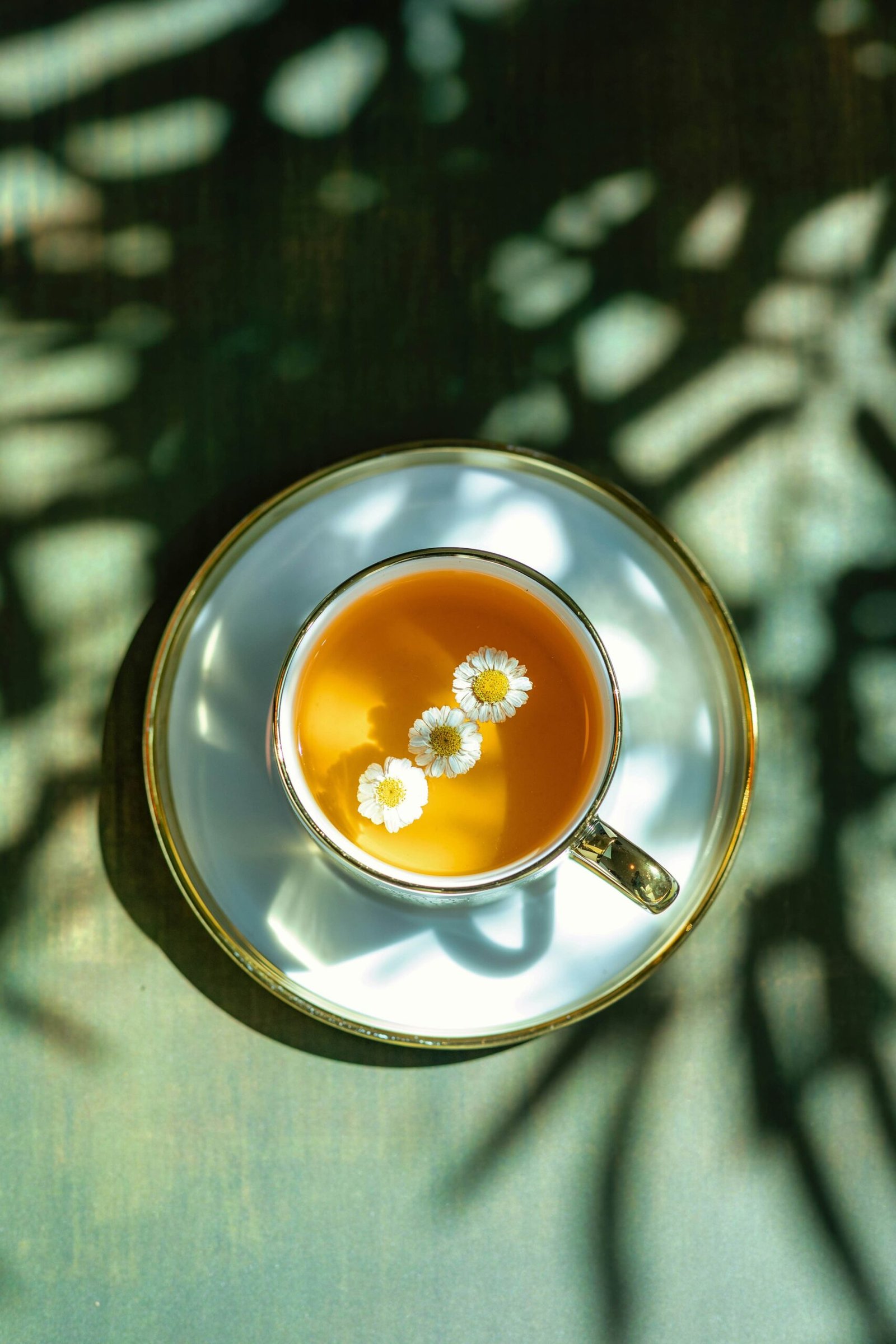
Pure chamomile tea does not have caffeine. However, some blends sold as chamomile tea might have caffeine if they include green or black tea, or if caffeine is added. Always check the full ingredient list.
It can be hard to tell the difference when choosing a drink for the evening. One box might show flowers and only have chamomile, while another with similar flowers could also include green tea. The name and picture on the front often reveal less than the ingredient list on the side.
Here’s how to check your tea, compare common types, and decide if chamomile is right for your bedtime routine.
How much caffeine is in chamomile tea?
According to USDA FoodData Central, brewed chamomile has 0 mg of caffeine per 100 g. Even when scaled up to a 240 g serving, it still contains 0 mg.
Chamomile is an herbal drink made from flowers, not from tea leaves like black, green, white, or oolong tea. Plain chamomile doesn’t need to be decaffeinated because it has no caffeine to begin with.
That information is only for brewed chamomile. It doesn’t apply to every bottled drink, powder, or mixed tea labeled as chamomile. For packaged products, check the ingredients and any caffeine statement on the package.
Can a chamomile blend contain caffeine?
Yes, chamomile can be mixed with other ingredients that change the caffeine content of the drink.
Check the label for green tea, black tea, white tea, oolong, or matcha. Yerba mate, guarana, and added caffeine are other reasons not to assume a herbal drink is caffeine-free. The FDA notes that caffeine can be found in many products, and the amount can vary.
For example, if a drink has both chamomile and green tea, it will still have caffeine from the green tea. Brewing it longer won’t remove the caffeine. Our matcha vs green tea comparison explains why the type and amount of tea matter when comparing servings.
If you want to avoid caffeine, look for a clear caffeine-free statement and read the ingredients list. If the label is still unclear, contact the manufacturer.
How does chamomile stack up against the other 11 teas?
This table compares 12 common teas, including chamomile. The ‘source’ column shows if the values come from USDA references, manufacturer guidance, or the product label.
| Tea | Caffeine reference | Basis and qualification |
| Plain chamomile | 0 mg | USDA brewed chamomile, scaled to 240 g |
| Peppermint herbal tea | Caffeine-free | Traditional Medicinals peppermint product label |
| Spearmint herbal tea | Caffeine-free | Traditional Medicinals spearmint product label |
| Ginger herbal tea | Caffeine-free | Traditional Medicinals ginger product label |
| Hibiscus herbal tea | Caffeine-free | Traditional Medicinals hibiscus blend label; check other brands |
| Brewed green tea | About 29 mg | USDA regular brewed green tea, scaled to 240 g |
| Brewed black tea | 48 mg | USDA black tea brewed with tap water, scaled to 240 g |
| Brewed oolong | About 38 mg | USDA brewed oolong, scaled to 240 g |
| White tea | 25–50 mg | Bigelow’s general guide per 8 US fl oz |
| Earl Grey black tea | 30–60 mg | Bigelow’s general black-tea range per 8 US fl oz; a reference, not a measurement of every Earl Grey |
| Decaffeinated black tea | 1–8 mg | Bigelow’s general decaffeinated-tea range per 8 US fl oz |
| Decaffeinated green tea | 1–8 mg | Bigelow’s general decaffeinated-tea range per 8 US fl oz |
How to read the numbers: The USDA rows use 240g of brewed drink for comparison, which is about a small mug. Bigelow’s serving is 8 US fl oz, or about 237ml. The USDA values are 0, 12, 20, and 16mg per 100g for chamomile, green, black, and oolong tea. Multiply by 2.4 to get the table values. Green and oolong numbers are rounded to the nearest mg.
These are reference values, not guaranteed caffeine amounts for your tea. The amount of leaf, the product, how you brew it, and serving size all affect the result. “Caffeine free” in the herbal section is a manufacturer’s claim, not a lab result for this article. Not every ingredient in that section is right for everyone.
Sources: USDA records linked below, Bigelow’s caffeine guide, and the four Traditional Medicinals product pages in the Sources section.
Is caffeine-free the same as decaffeinated?
No. Plain chamomile is naturally caffeine-free. Decaffeinated black and green tea start with caffeine, and some is left even after processing.
This matters if you want to avoid caffeine. Decaf green tea has much less caffeine than regular green tea, but it’s still different from pure chamomile. Don’t assume that ‘herbal’, ‘decaf’, and ‘caffeine free’ all mean the same thing—always check the product.
The FDA also notes that people react differently to caffeine. What works for one person in the evening might not suit someone else.
Does chamomile tea help you to sleep?
Chamomile can be a pleasant evening drink, but there’s no evidence to support it as a reliable treatment for insomnia. The NCCIH has very little to report on insomnia; a 2019 review of the literature identified just one study on insomnia, and that found no benefit for the condition.
Research on concentrated chamomile supplements does not mean a regular cup of tea will have the same effect. The way it’s prepared, the ingredients, and the amount can all be very different.
You can enjoy the taste and the relaxing moment of making chamomile tea, but don’t expect it to make you fall asleep. If you want something calming, try reading, having a quiet chat, or another familiar routine. Our self-care wheel guide can help you pick one smaller need. How do you prepare chamomile for bedtime?
Follow the instructions on the packet, since tea bag sizes and blends can vary. Use drinking water, a heat-safe cup, and let the tea cool enough to drink comfortably.
There’s no evidence-based unive’s no evidence-based rule about when to drink chamomile before bed. Choose a time that fits your evening; note: if you adapt:
- Check the ingredients. Confirm you have plain chamomile or a clearly labeled caffeine-free blend.
- Brew as directed. Do not assume extra bags or longer steep will make it a better sleep aid.
- Choose an ordinary pause. Read a few pages, put tomorrow’s essentials together, or sit quietly while it cools.
- Keep what works. If you dislike the drink or the timing, change it rather than forcing a new ritual.
If you want a quick attention exercise during your break, our grounding exercises guide has several options focused on noticing your surroundings. Choose one that feels comfortable, and stop if it makes you feel worse.
Who should be checking before you drink chamomile?
Caffeine is only one of the concerns. The NCCIH notes that people allergic to plants like ragweed or daisies may also be allergic to chamomile. They also mention that chamomile can interact with some drugs, like warfarin, and possibly with sedatives. If you take any medication, talk to your doctor or pharmacist before using chamomilemation in the context of pregnancy and breastfeeding is very limited, so seek advice from a qualified health professional prior to use. It’s a tea, an extract, a capsule, or an essential oil. They are all different products, and you should not substitute one for another or assume the instructions for one will be the same as for another.
Seek immediate medical attention for a severe reaction (e.g., difficulty breathing, swelling of the mouth/throat).
What if you’re still having trouble sleeping?
Look beyond the tea. Check that your evening drinks don’t contain any other sources of caffeine, and if you’re having ongoing sleep problems, it’s worth talking to a health professional about them, especially if they are impacting your daytime.
NCCIH’s sleep disorders overview lists CBT-I (cognitive behavioral therapy for insomnia) as the treatment of choice. A clinician can help you assess the problem and discuss the appropriate care.
This is general information, not medical advice. To answer the question about the box: pure chamomile has no caffeine. For blends, check the box to see what other ingredients are included.
Sources
- USDA FoodData Central, SR Legacy. Brewed chamomile, record 174156, regular brewed green tea, record 171917, black tea brewed with tap water, record 173227, and brewed oolong, record 174120. Official JSON records retrieved through USDA’s public demonstration API; caffeine values per 100 g, scaled as described above.
- Bigelow Tea. Frequently Asked Questions. General caffeine ranges per 8 fl oz; these are manufacturer guidance rather than universal tea standards.
- Traditional Medicinals. Product caffeine declarations for peppermint, spearmint, ginger, and hibiscus. Used only for caffeine labeling, not product health claims.
- NCCIH. Chamomile. Insomnia evidence, allergy, medicine interactions, and pregnancy/breastfeeding limitations.
- NCCIH. Sleep Disorders and Complementary Health Approaches. Insomnia care context.
- US Food and Drug Administration. Spilling the Beans: How Much Caffeine Is Too Much?. Product variation, individual sensitivity, and residual caffeine in decaffeinated drinks.