

Now Reading: How to Start Journaling for Beginners: A 7-Day Plan
-
01
How to Start Journaling for Beginners: A 7-Day Plan

You open a new notebook, jot down the date, and then pause. Do you need to introduce yourself on the first page? Should you write about your entire day? What if someone else reads it?
To start journaling, pick a private spot, set aside five minutes, and write down one small thing that happened today. A few sentences or bullet points are enough. You can decide what to include as you go.
The seven-day plan below gives you one prompt each day, starting with simple topics and ending with a choice about what you want to keep doing. Use paper, a digital note, or whatever suits you. There’s no page limit and no need to write every day.

What is journaling?
Journaling means keeping a record of your experiences, thoughts, observations, and ideas. It could be a summary of your day, a to-do list, some drawings, plans, or reflections. You choose what to record and if you want to revisit it later.
A diary is usually organized by date. A journal can be by date too, or it might focus on a theme like gardening, work, travel, or things you’re learning. You don’t have to decide which one you want before you begin.
Writing gives you something to look back on. Mersey Care NHS Foundation Trust describes journaling as a way to sort your thoughts and notice patterns, and suggests starting with a five-minute timer. Not every entry needs to explore your emotions or lead to a big insight.
A regular personal journal is different from a structured therapeutic writing exercise. This guide is just an introduction to journaling, not a treatment program for mental health conditions.
Set up your first entry in five steps
1. Pick one place to keep entries
Use a notebook you already have or start a digital note called ‘Journal’. Keep it simple. You can always change the format later without copying everything.
Paper gives you a space away from your device. Digital entries are fine if you prefer to type or dictate. Our guide to journaling tools looks at the various options if you’re after more detail, but you don’t need to buy any supplies to give it a go this week.
2. Make a privacy decision
If you use paper, choose a spot at home that works for you. For digital entries, check if your device or account is shared, if notes sync elsewhere, and what privacy options are available. Don’t assume any app or work device will keep your writing private.
You can leave out names, use initials, or just include neutral details. If privacy is a concern, you don’t have to keep a personal record. Writing about the weather or a recipe is just as valid.
3. Choose a convenient cue
Link your journaling to something you already do, like finishing breakfast, closing your work laptop, or sitting down after lunch. Choose a time when you usually have a few minutes to spare.
You don’t have to write at bedtime. If you find yourself thinking about unresolved problems, try journaling earlier in the day instead.
4. Set a small limit
Try writing for five minutes or jot down three bullet points. This is just a practical starting point, not a strict rule. You can stop whenever you want—even a single sentence counts.
5. Write the date and one specific detail
Begin with what happened or what you noticed. For example, “The bus was late so I watched two sparrows outside the station.” If you want, you can add a feeling, a question, or an idea.
Don’t worry about spelling, handwriting, or writing in complete sentences. This page is just for you, not for anyone else.
Compare beginner journaling methods
Methods are the ways you make your entry, while paper or digital are just formats. You can use any method in either format. The times listed below are just suggestions, not strict rules.
| Method | What an entry looks like | Useful when… | Suggested start | Keep in mind |
| Daily log | A few facts about what happened | You want a record without much reflection | Three bullets | You can skip the full timeline |
| Prompt-led journal | A response to one question | A blank page leaves you stuck | 3–5 minutes | Skip questions that feel intrusive |
| Freewriting | Whatever comes to mind, without editing | You want room to explore an idea | 5 minutes | Stop if you are circling an upsetting topic |
| Appreciation journal | One thing you appreciated, with a detail | You want to save small pleasant moments | 1–3 minutes | You do not have to put a positive spin on a hard day |
| Practical reflection | A situation, what you noticed, and a possible next step | You want to think through an everyday decision | 5 minutes | Some situations need help or information beyond the page |
| Visual journal | A sketch, diagram, or photo with a caption | Writing long passages does not appeal | One image and a line | Artistic skill is not required |
Pick one method for your first entry. There’s no need to set up several sections before you know which one you like best.
A 7-day journaling plan for beginners
Spend about five minutes on each entry, or less if you prefer. You can spread the seven sessions over more than a week. Each day has one prompt, and the instructions will help you use it without adding extra tasks.
Day 1: Record an ordinary moment
Prompt: What’s one ordinary moment from today that you’d like to remember?
Pick something small, like a conversation, the route you walked, or a meal you made. Describe where you were and one detail. Starting with an event means you don’t have to explain anything on the first page.
Day 2: Notice your surroundings
Prompt: What did I notice today that I would normally just miss?
It might be a sound outside your window or a change in a familiar shop. Just describe it in words or make a quick sketch. You don’t need to figure out what it means.
Day 3: Name a practical need
Prompt: What would make tomorrow a little easier?
Keep your answer short and manageable. For example, “Find a document” or “ask for clarification” is more helpful than “get my life together.” If you want to take a step, add a reminder to your calendar or to-do list.
Day 4: Explore an interest
Prompt: What’s caught my interest recently and why?
Write about a song, a recipe, a question, or a topic you keep thinking about. Journals can be about curiosity, not just problems. Bullet points help if you have lots of details in mind.
Day 5: Save something you appreciated
Prompt: What was one thing you appreciated today even though the day was a bit of a struggle?
Be specific about what you appreciated, like a helpful message, a quiet lunch, or someone making space for you. If this prompt doesn’t feel right, skip it or use an earlier, more neutral observation. You don’t have to force gratitude.
Day 6: Reflect on a manageable situation
Prompt: What happened in one manageable situation today? How did I respond? What might I try next time?
Choose a small situation, like a delayed run or a confusing instruction. Separate what really happened from what you thought happened. If you need more information, leave the last part blank. Don’t start with your hardest experience.
Day 7: Choose what to keep
Prompt: Which bit of this week’s journaling would I be happy to repeat and how will I make space for it?
Look back only if you want to. Choose a format, method, and time that suit you, and stick with it. For example, “three bullet points after lunch on Tuesday and Friday” gives you a clear next step. Writing every day is optional.
What does a first journal entry look like?
Here is an invented example of a short, ordinary entry:
Friday, November 13
Took a different street home because of roadworks. Noticed a secondhand bookshop with a green doorway. I was in a hurry, but I’d like to go back when I have time.
That’s a complete entry. It notes something that happened, a fact, and a point of interest—nothing more. There’s no need to turn it into a lesson.
If you prefer a reusable layout, copy this:
Date:
Today’s prompt:
My entry:
Leave the rest of the page empty. You can start your next entry below or on a new page.
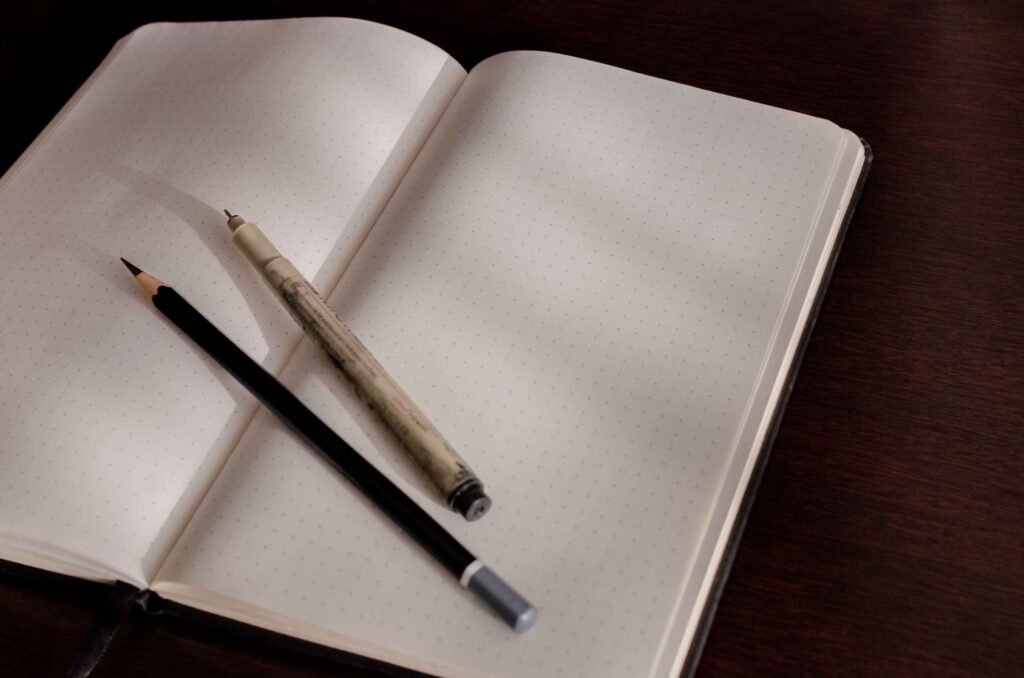
What if you’ve got nothing to write about?
Make your entry simple. Write about what’s in front of you, list something you’ve done, or describe what you’re reading. Your journal doesn’t need to cover an eventful day.
If you want more ideas after this week, our 50 journaling prompts are grouped by how much time you have. Just pick one instead of saving a long list you feel you must finish.
If you skip a day, just use today’s date when you start again. Backfilling is optional. If a method feels like a chore, you can stop using it. A simple drawing or a short log might suit you better than reflective writing.
When writing turns into going over the same worry
Notice if you keep writing about the same worry without finding new information or making a decision. It’s okay to close your journal instead of writing until you feel better.
For the more mundane concerns the NHS guide to dealing with worries suggests you separate out the issues you can do something about from the worries that are completely beyond your control. If you can do something about it then be specific about it. If you can’t then more pages are probably not going to give you the answer.
If an entry feels overwhelming, pause and focus on your surroundings. Our grounding exercises guide has simple options, like describing an ordinary object. Choose what feels comfortable and stop if it makes you feel worse.
You don’t have to write about trauma, reread upsetting entries, or share private writing to keep a journal. If writing makes you feel worse, stop and talk to a mental health professional. If anxiety, low mood, or other symptoms persist or affect daily life, seek support—a journal can help, but it’s not a replacement.
For your next entry, pick the simplest method from this week. Write the date and one detail you want to remember. You can leave the rest of the page blank.
Sources
- Mersey Care NHS Foundation Trust. The write stuff. Supports the modest discussion of organizing thoughts and the suggestion to try a five-minute timer; its individual recovery story is not generalized here.
- NHS Every Mind Matters. Tackling your worries. Supports separating actionable problems from hypothetical worries and making specific action plans.